THE TIMELY CARE ACCESS MODEL
Better access.
One connected
care journey.
Follow the clinical need from the first request to appropriate care and a clear next step.
A proposed evidence-informed operating model for local evaluation.

THE OPERATING MODEL
Accountability at every handoff
Select a function to see the action, responsible role, and evidence that the work occurred.
Preserve the original clock
Carry the first request time across referrals, rescheduling, and transfers. Track time to appropriate care and time to a communicated plan separately.
Confirm the next owner
Clinical responsibility and coordination duties must be explicit. A scheduling status alone cannot transfer responsibility.
Keep unmet needs visible
Review active, overdue, and unsuccessful requests. Administrative closure does not establish that appropriate care occurred.
Operating specification and accountable roles
| Function | Required action | Accountable role | Completion evidence |
|---|---|---|---|
| Recognize need | Register the request once; capture barriers and contact preferences. | Intake lead | Episode ID and original timestamp |
| Assess urgency | Clinical review sets route, due time, and safety instructions. | Designated clinical reviewer | Priority, rationale, reviewer, due time |
| Arrange care | Receiving service accepts; match capacity and address barriers. | Access coordinator with service lead | Named receiving team and agreed next step |
| Deliver care | Complete the appropriate assessment, advice, test, or treatment. | Treating clinical team | Qualifying clinical event and timestamp |
| Confirm follow-through | Review results; inform patient; confirm next owner and actions. | Current episode clinical owner | Communicated plan and acknowledged handoff |
| Review results | Examine delays, failed access, equity, safety, and workload. | Executive access council | Actions with owners and review dates |
Priority structure and clinical commitments
Clinical leaders must approve condition-specific timing and escalation. These categories are an operating structure, not a clinical triage algorithm.
| Priority | Scheduling commitment | Escalation and protection |
|---|---|---|
| Emergency | Immediate clinical assessment and emergency routing under established protocols. | Do not place in the routine queue or await routine authorization. |
| Time sensitive | Condition-specific deadline selected by qualified clinicians. | Escalate threatened deadlines before expiry; arrange a safe alternative. |
| Routine | Prospectively agree a clinically acceptable window and patient preferences. | Track original request age; offer alternatives with informed agreement. |
| Planned follow-up | Book against a clinical recall or surveillance due date. | Do not repeatedly postpone planned care to accommodate new requests. |
| Changing or uncertain need | Prompt qualified review determines or revises the route. | Reassess new information; retain the original deadline and revision history. |
CARE JOURNEY EXPLORER
Where does the wait accumulate?
Explore illustrative elapsed time across a pathway. Adjust the intervals to expose handoff delays and the responsibility for each next action.
Build the timeline
DaysThis illustration uses sequential, nonoverlapping intervals. Real work may occur in parallel and must be reconstructed from timestamps.
The patient’s elapsed time
BARRIER TO ACTION
Make the next step achievable
A CONNECTED RECORD
One need. One original request time.
Link the clinical question, current owner, original and revised due times, barriers, service events, and disposition in one auditable episode.
Emergency escalation follows established clinical protocols and bypasses the routine scheduling pathway.
Patients may enter any care setting and move between services. Hospitalization is never a required step in this model.
View the complete conceptual architecture
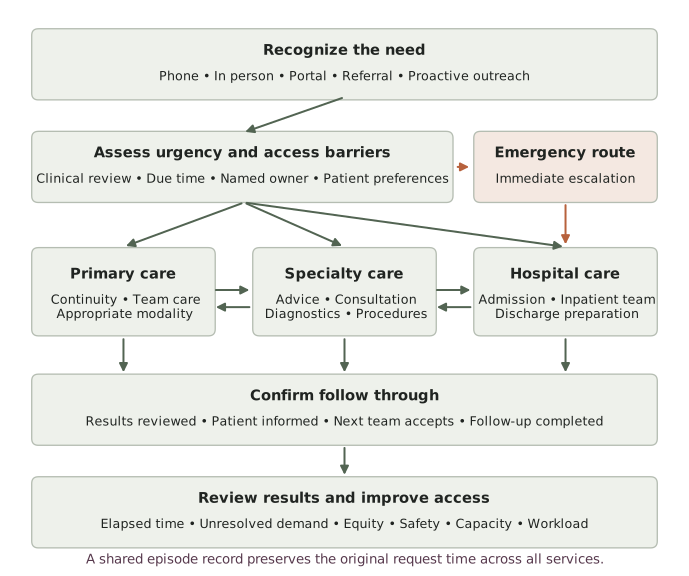
Original conceptual synthesis. The combined model requires local evaluation.
CAPACITY LAB
Test the demand and capacity balance
Compare a current operating pattern with a proposed capacity change. The chart updates immediately as you change the assumptions.
Weekly assumptions
Enter completed-care capacity in comparable work units within the selected service. Nominal appointment slots and staffed usable capacity may differ.
No administrative removals are assumed. Unused capacity does not create negative backlog.
Unresolved requests over time
Inspect the weekly calculation
Read the limits of the scenario
- Demand and usable capacity remain constant across the chosen weeks.
- Requests are treated as comparable work units within a service.
- Complexity, urgency, seasonality, rework, and cross-service constraints are not modeled.
- A decreasing backlog does not establish safe waiting times or improved outcomes.
Test the business case
Include clinical triage, navigation, interpretation, specialist advice, and data maintenance. Track staff overtime, inbox work, and patient burden alongside throughput.
Released staff time becomes usable capacity only when it can be redeployed to the needed work. Estimated savings require a separate economic evaluation.
ACCESS SCORECARD
Measure care delivered and needs still open
Use aggregate counts from a defined reporting cohort. The examples demonstrate denominator rules and can be replaced with your own nonidentifiable planning totals.
Episodes due during the reporting period
Known-due cohort = on-time care + late care + open overdue + other dispositions. Unknown or missing due times remain visible separately.
Disposition by care setting
Other dispositions may include refusal or inability to contact. They remain in the known-due cohort and do not count as on-time care. Document justified duplicate and erroneous-order exclusions separately.
EQUITY REVIEW
Look beneath the aggregate
Separate illustrative cohort by communication need. This exercise is independent of the service totals above. Missing group information stays visible. Choose an appropriate local small-cell policy before using real aggregates.
Display suppression is not a complete privacy method. Unadjusted differences prompt investigation; they do not identify a cause.
Metric definitions and reporting safeguards
| Measure | Operational definition | Reporting safeguard |
|---|---|---|
| On-time appropriate care | Episodes with a predefined qualifying clinical service completed by the original due time / all eligible episodes due in the period. | Open overdue and failed-access episodes remain in the denominator. Report missing due times separately. |
| Elapsed time | Original request to qualifying service; separately, original request to communicated episode plan or resolution. | Median and 90th percentile among completed episodes, paired with open-episode age and overdue counts. |
| Unresolved demand | Count and age of active episodes, including those overdue for the next clinical action. | Show entries, completed care, other dispositions, and reopening; never use closure alone as success. |
| Referral follow-through | Episodes with completed specialty input, reviewed recommendation, and patient communication / referral episodes due for completion. | Separate advice-only resolution from in-person care still required and from external completion. |
| Primary care availability | Third next available suitable appointment by visit type and continuity option. | Snapshot supply measure; pair with actual patient waits and unsuccessful requests. |
| Hospital transition times | Admission decision to inpatient management and to bed transfer; discharge to required completed follow-up. | Keep intervals separate; report clinical route, urgency, and overdue follow-up. |
| Patient burden and equity | Reported attempts, travel, cost barriers, and understanding; on-time rates by relevant population groups. | Use consistent eligibility, review missing data, protect small cells, and show group denominators. |
| Safety and capacity | Delay-related incidents, deterioration while waiting, return visits, continuity, overtime, inbox work, and staffed capacity. | Use clinical review and case-mix context; do not treat all return visits as caused by access failure. |
Pair speed with continuity, safety, and workload
Use median and 90th-percentile waits among completed episodes together with the age of open episodes. Review clinical deterioration, delay-related incidents, follow-through, continuity, patient burden, and staff capacity. A single composite score can conceal worsening performance in one service.
PILOT WORKBOOK
Turn the model into a testable operating plan
Assign ownership, document the evidence required, and track implementation tasks. Ninety days is a proposed launch sequence; sustained evaluation continues afterward.
Local pilot decisions
Implementation sequence and decision evidence
| Period | Work to complete | Responsible leads | Decision evidence |
|---|---|---|---|
| Days 1 to 30 | Select one primary–specialty–discharge pathway; reconcile records; map barriers; establish baseline and clinical timing rules. | Clinical sponsor, operations, analytics, patient partners | Agreed cohort, reliable timestamps, denominator rules, capacity assessment |
| Days 31 to 60 | Pilot intake, triage, receiving-team acknowledgment, navigation, and daily overdue review. | Service leads and access coordinator | Documented ownership; unresolved episodes reviewed; safety issues acted on |
| Days 61 to 90 | Refine templates and handoffs; compare with baseline and a suitable comparison service where feasible. | Quality and analytics with clinical leads | Timeliness, continuity, equity, workload, and safety reviewed together |
| After day 90 | Continue observation and extend only if results and resources support it. | Executive access council | Sustained improvement, adequate follow-up, and no unacceptable balancing harm |
Institutional investigation guide
| Question | Evidence to obtain | Interpretive check |
|---|---|---|
| Where is time lost? | Request, triage, authorization, acceptance, service, result, and follow-up timestamps. | Reconstruct one episode across systems; validate timestamp meaning. |
| Who does not reach care? | Open queues, cancellations, nonattendance, declined referrals, unreachable patients, and external care. | Sample unsuccessful journeys as well as completed visits. |
| Is capacity insufficient? | Staffed templates, completed work, complexity, absences, rework, and coverage. | Separate usable capacity from nominal schedules. |
| Who is accountable at a handoff? | Referral rules, clinician assignment, acknowledgment logs, and escalation records. | Compare written policy with actual practice. |
| Whose barriers remain unresolved? | Patient interviews and data on language, disability, geography, coverage, and financial constraints. | Seek consent, protect privacy, and avoid drawing conclusions from very small groups. |
| Did improvement cause better outcomes? | Review baseline trends, comparison data, safety reviews, staffing changes, and patient experience. | Consider selection, seasonality, concurrent interventions, and regression to the mean. |
Include patients who completed care, patients still waiting, and people whose access failed. Trace episodes across systems and compare written handoff policy with actual practice. Local audits require an appropriate sampling and interpretation plan.
Evaluate change before expanding
Establish several months of reliable baseline data where available. Prespecify outcomes, eligible cohorts, exclusions, and safety escalation. Review weekly patterns and use an appropriate comparison or longitudinal design when feasible.
Scale only when improvement persists and resources support it. A favorable month or a completed checklist does not validate the model.
RESEARCH LIBRARY
Trace the model back to the evidence
Explore the research, examine the limits, and open the original publications. Published study results remain separate from the dashboard’s hypothetical planning scenarios.
PRIMARY CARE
Advanced access findings
Study counts are not effect sizes or certainty ratings. Studies differ and may contribute to more than one category. For ED use, two studies did not report significance and one was not significant.
Adadja et al. (2026) ↗HOSPITAL TRANSITIONS
Individualized discharge planning
Moderate-certainty review evidence, predominantly older medical patients. The readmission estimate is a relative effect. These results do not predict this model’s impact.
Gonçalves-Bradley et al. (2022) ↗Evidence matrix from the report
| Source | Design and scope | Contribution | Key limitation |
|---|---|---|---|
| Levesque et al., 2013 | Conceptual access framework | Access includes the ability to reach and use care. | Framework rather than intervention evaluation. |
| Adadja et al., 2026 | Systematic review; 29 studies | Responsive primary care scheduling. | Heterogeneous designs; limited ED evidence. |
| Engström et al., 2025 | Systematic review of personal continuity | Protect continuity alongside speed. | Much evidence is observational. |
| Peeters et al., 2024 | Systematic review; 72 studies | Specialist advice and referral design. | Low or very low certainty; heterogeneous endpoints. |
| Olayiwola et al., 2016 | Cluster-randomized cardiology study | Separate advice from visit pathways. | One setting and specialty; pathway selection matters. |
| Patel et al., 2018 | Single-system referral analysis | Track the full referral process. | Historical and not nationally representative. |
| Janke et al., 2026 | Multicenter observational study | Measure inpatient management handoff. | Variation does not establish effects of a repair. |
| Gonçalves-Bradley et al., 2022 | Cochrane review; 33 trials overall | Individualized discharge planning. | Predominantly older medical patients; costs uncertain. |
| Murphy et al., 2026 | Systematic review; 25 studies | Track authorization-related barriers. | Total attributable harm remains uncertain. |
| W. C. Chen et al., 2025 | Radiation oncology quality improvement | Improve authorization information flow. | Nonrandomized and setting-specific. |
| D. W. Chen et al., 2025 | Cross-sectional portal assessment | Provide multilingual entry routes. | Login accessibility rather than clinical outcomes. |
| M. Chen et al., 2024 | Cancer navigation systematic review | Address patient-specific barriers. | Oncology evidence requires adaptation elsewhere. |
| Vakkalanka et al., 2026 | Matched Medicare comparison | Consider selected home-care options. | Residual selection and confounding possible. |
Read the investigative research brief
Improving Timely Patient Access Across the Care Continuum
A targeted narrative evidence review and proposed operating model by Kelly Emrick. Research reviewed through October 23, 2026.
No institutional patient data or interviews were collected. The integrated model remains a proposal for local evaluation.
Download the complete Word reportThe patient waits across organizational boundaries
A patient can get an appointment and still not receive timely care. The visit may produce an unaccepted referral, a diagnostic test that cannot be scheduled, or a hospital discharge plan that no outpatient team has agreed to carry out. Each department can record a completed task while the clinical question remains unresolved. An investigation of access must therefore follow the patient’s need across those boundaries and ask who remained responsible when progress stopped.
Levesque et al. (2013) describe access through service characteristics and people’s corresponding abilities to recognize a need, seek help, reach services, pay, and engage. This broader definition prevents a narrow scheduling metric from standing in for the patient’s experience. A timely appointment that cannot be reached, afforded, understood, or used appropriately does not fulfill the purpose of access. The Institute of Medicine (2015) likewise examined scheduling across primary, specialty, hospital, and postacute services as a systems problem.
The investigative hypothesis developed here is that some delay comes from insufficient staffed capacity, while another portion comes from how existing capacity is organized and how work passes between teams. These causes require different responses. A clinic cannot sustainably schedule its way out of a persistent demand–capacity deficit. Conversely, hiring another clinician may have little effect if referrals remain unreviewed or patients repeatedly encounter incomplete preparation requirements. Local evidence must establish the contribution of each mechanism.
The report proposes defining timely access as completion of a clinically appropriate action within a prospectively documented timeframe, with an accountable team responsible for communication and follow-through. Timeliness is conditional on need. An emergency, a time-sensitive diagnostic concern, a routine consultation, and planned surveillance require different pathways. A universal promise that every patient should receive the same service within the same number of days would conceal these differences.
Three questions should guide an institutional investigation. Where does elapsed time accumulate? Which patients fail to receive the intended care? What happened to their clinical needs while they waited? These questions require patient-level chronology and outcome classification. Averages calculated only among completed appointments exclude people who remain in the queue or abandon the process. Administrative closure can also obscure failure when staff mark a referral complete after unanswered calls.
The proposed model retains the original request timestamp even when responsibility changes. It records the interval to a first qualifying clinical action and the longer interval to a communicated plan or documented resolution of the episode. Clinical resolution means the presenting question has an agreed disposition or ongoing management plan; it does not imply a cure. Diagnostic steps, treatment, and follow-up can remain active after the first appointment. These distinctions make the pathway auditable without pretending every care need follows a single linear course.
Primary care access must preserve continuity
Adadja et al. (2026) synthesized 29 studies of advanced access. Appointment waits improved in all 23 studies that measured that outcome, while results on continuity and satisfaction were less consistent. Evidence of reduced emergency or urgent care use was limited. Figure 1 displays study counts, not pooled effects. This supports testing more responsive scheduling while withholding claims that it will reliably reduce hospital demand.
Our proposed primary care design begins with measuring requests by day, urgency, visit type, and the work required to resolve them. The team then adjusts appointment templates, planned follow-up, same-day capacity, and coverage for absences. The appropriate mix will differ by panel complexity and staffing. Holding every slot until the day of service can disadvantage patients who need transportation, interpreters, or time away from work. Planned chronic care and surveillance must remain bookable.
Continuity deserves a separate measure. Engström et al. (2025) found that higher personal continuity in general practice was associated with better outcomes, including lower mortality and hospital use; observational evidence leaves residual confounding possible. The model therefore offers a patient’s usual clinician or established team where appropriate and records when the patient chooses a faster alternative. A short wait should not automatically outweigh a clinically valuable ongoing relationship.
A protected daily review of unresolved requests can identify patients whose condition has changed or whose original route failed. Team-based work should follow clinical scope, competency, and escalation arrangements. Leaders should fund the time required for telephone review, electronic advice, and coordination. Otherwise, reducing the visible appointment queue may move unfinished work into clinician inboxes.
Specialty access requires a completed clinical exchange
Electronic consultation can provide specialist advice without requiring every question to become an in-person visit. Peeters et al. (2024) reviewed 72 studies and found promising access results, but substantial heterogeneity and low or very low certainty limited conclusions about effect size. Advice turnaround and the waiting time for an in-person visit are different outcomes. Both must be measured when a pathway uses electronic consultation.
In a cluster-randomized cardiology study, Olayiwola et al. (2016) reported median consultation times of 5 days for patients using electronic consultation, 29 days for intervention patients taking a traditional referral route, and 24 days in the control group. These pathway-specific figures do not mean that all specialist appointments became 19 days faster. The operational lesson is to identify which questions advice can answer and which still require examination, testing, or a procedure.
The proposed model requires a referral to state the clinical question, relevant findings, urgency, and information needed for safe review. Receiving teams acknowledge acceptance or return a specific request for clarification. The sending team retains coordination responsibility until acceptance is confirmed. Clinical responsibility follows the actual care arrangement and must be explicit; a scheduling status alone cannot transfer it. Missing information should trigger assistance and clarification rather than an unexplained rejection that restarts the patient’s wait.
Patel et al. (2018) examined referrals from a large primary care network to 20 specialties and identified gaps involving scheduling, clinic variation, waiting time, and geographic access. The single-system, historical study supports examining the entire referral process but should not be treated as a current national failure rate. In the proposed model, receipt of a specialist note is only one checkpoint. The referring team must review the recommendation, communicate the next step, and confirm that necessary downstream actions are assigned.
Practical options include specialty triage sessions, agreed consultation criteria, pooled appointments within clinically interchangeable services, reserved urgent capacity, and direct communication when a referral cannot be accommodated. Pooled scheduling must respect patient preference, continuity, accessibility, and insurance participation. Electronic advice is not an obligatory gate for all referrals. It should not delay an examination when the referring or reviewing clinician considers one necessary.
Specialty capacity should be counted in clinical work units that reflect complexity and modality. A five-minute advice response and a complex new-patient visit are not interchangeable slots. Protected specialist advice time, primary care follow-up time, interpretation, and navigation all require resources. The model tracks rework and repeat referrals so apparent referral avoidance isn't mistaken for successful care when patients return with the same unresolved need.
Hospital access extends through discharge
Hospital access includes emergency assessment, accepted admission, initiation of inpatient management, transfer when needed, and a safe transition out of hospital. Janke et al. (2026) identified substantial variation in the time from an admission decision to inpatient management across 56 hospitals. The study distinguishes clinical handoff from physical movement to a bed. It supports measuring both intervals and clarifying which team is responsible while a patient boards in the emergency department.
The proposed model uses an explicit receiving clinician or team, a documented handoff, medication and monitoring responsibilities, and an escalation route for deterioration. Hospital operations should review staffed beds, diagnostic and procedural bottlenecks, discharge needs, and postacute availability together. Do not shorten the emergency department queue through unsafe discharges or inappropriate transfer denials. Local investigations should examine safety outcomes and patients whose transfer requests were not accepted.
Discharge planning is also an access intervention. Gonçalves-Bradley et al. (2022) found modest benefits from individualized planning, with moderate-certainty evidence for length of stay and readmission outcomes in predominantly older medical patients. Figure 2 presents the estimates with their confidence intervals. The findings do not establish cost savings or justify a uniform earlier-discharge target.
Before departure, the next team should receive an actionable plan, pending-result responsibilities, medication information, and the intended follow-up timeframe. Patients should know who will contact them and what to do if that contact fails. The model verifies completion of the next clinically indicated step. An appointment printed on discharge instructions remains an uncompleted task until the patient can use it and the receiving service confirms what occurred.
Barriers must be addressed throughout the pathway
Authorization, affordability, transportation, language, disability access, and digital requirements can interrupt every stage. Murphy et al. (2026) reviewed evidence linking prior authorization with delays and adverse outcomes, while acknowledging that the available studies cannot quantify total attributable harm. These barriers belong in the same episode record as clinical and scheduling events. A faster insurer decision is useful only if the remaining pathway delivers appropriate care.
Workflow redesign can help. W. C. Chen et al. (2025) associated clinically integrated authorization processes in radiation oncology with fewer denials and shorter decision times. This nonrandomized, setting-specific result supports testing better information flow; it does not establish that technology can remove all utilization-management barriers. Local analysis should separate time awaiting a payer decision from delays in submission, missing records, and appointment availability.
Language access must begin before an account is created. D. W. Chen et al. (2025) found gaps in the language accessibility of hospital portal login pages. The study did not evaluate all portal functions. The model maintains assisted telephone and in-person routes, records communication needs, and checks whether the patient understood the plan. Digital participation should be a choice that facilitates care rather than a condition for entering the pathway.
Navigation offers a practical way to address repeated barriers. M. Chen et al. (2024) reviewed 59 articles on cancer treatment navigation and found generally favorable results across several access and experience outcomes, with variation in programs and study designs. Applying those findings to all specialties requires testing. The proposed model targets additional navigation based on clinical and access risk while providing a basic level of assistance to every patient.
Hospital-at-home services may expand options for selected patients. Vakkalanka et al. (2026) reported favorable short-term associations in a matched Medicare comparison, but patient selection and unmeasured differences constrain causal interpretation. In this model, home hospitalization requires clinical suitability, patient agreement, appropriate support, and an escalation plan. Review eligibility, acceptance, refusal, and exclusion reasons for inequity rather than assuming every home can safely support hospital-level care.
The model does not assign blame to patients when care is missed. It distinguishes informed refusal, inability to contact, unaffordable care, transportation failure, clinical redirection, and a service cancellation. Staff document attempts and the remaining safety concern. Clinical staff review unresolved requests before administrative closure. Patients retain the right to decline care, and successful outreach does not mean pressuring them to accept a service.
Capacity governance and economic evaluation
Waiting lists grow when incoming work exceeds completed work over time. The basic accounting identity is that the next backlog equals the current backlog plus new eligible requests, less completed care and separately documented other dispositions. For illustration only, 120 new requests and 100 completed episodes each week would add 80 unresolved episodes over four weeks if no other dispositions occurred. This example is arithmetic, not a forecast or an estimate from the literature.
A capacity review should distinguish nominal slots from usable capacity. Staffing, visit length, room availability, required testing, and patient preparation determine whether a slot can meet a particular clinical need. Review repeat contacts, returned referrals, avoidable rebooking, and canceled sessions before interpreting demand as entirely new work. Some improvements will require additional clinical capacity, extended coverage, or external partnerships; make those requirements explicit rather than absorbing them as unpaid work.
The access council should include executive operations, primary care, specialty care, hospital medicine, nursing, scheduling, revenue cycle, quality, analytics, and patient representation. Its role is to resolve conflicts that individual departments cannot settle. It approves measure definitions and capacity decisions, reviews safety signals, and assigns responsibility for failed handoffs. An operational huddle can address today’s unresolved work; a monthly review examines recurring causes and resource needs.
Avoid a single composite access score in the first version. A weighted index can make deterioration in one service disappear behind improvement in another. Present the core measures together, retain service-specific detail, and compare like urgency categories. Equity review should examine both unadjusted experience and clinically comparable groups. Statistical adjustment should clarify case mix without hiding structural disadvantage.
The business case should include navigation, clinical triage, specialist advice, interpreter services, data maintenance, patient travel, and the burden placed on families. Separate cash expenditure, staff time released, usable clinical capacity, and potential avoided utilization. Time released becomes capacity only if it can be deployed to needed work. Projected savings from reduced admissions should remain scenarios until measured with an appropriate comparison and attention to changes in demand.
Department incentives also matter. An intervention that improves referral completion can initially increase specialty demand, exposing previously unmet need. That is not necessarily failure. The evaluation should ask whether appropriate care became more timely and whether the organization added the capacity needed to sustain that improvement. Payment and productivity arrangements should recognize clinically useful work beyond face-to-face visits without rewarding avoidance of necessary care.
© 2026 Kelly Emrick. Proposed model for local evaluation.
Clinical timing and escalation require qualified local review. Use aggregate planning information only.