An investigation by Kelly Emrick · November 11, 2026
The Missing
Needle
Breast biopsy shortages and the threat to timely diagnosis
When the next necessary procedure depends on a missing consumable, the measure of leadership is what happens to the patient next.

The investigation
A functioning scanner. A missing link.
A diagnostic service can remain open while a specific procedure becomes unavailable.
The supply warning
A manufacturing hold affecting ATEC needles has arrived alongside an existing stereotactic breast biopsy needle shortage. These are distinct events, with different safety instructions and recovery milestones.
The unanswered question
The public records establish disruption. They do not establish a national count of delayed patients, cancer progression, or deaths attributable to these shortages.
Report scope: documentary investigation and critical research synthesis.
The leadership obligation
Follow each affected episode through clinical review, an executable alternative, completed care, and an explained result. A referral sent is not a referral completed.

Editorial illustration. People and setting do not depict a reported incident.
The central argument
Recovery should be measured through completed diagnostic care, not merely resumed shipments.
Inventory, referrals, pathology and patient communication are connected responsibilities. The endpoint is a documented diagnostic disposition and ownership of what comes next.
Follow the evidence
The documented sequence
Two device events. Several different clocks.
Select an event to distinguish the product action, public notice, and recovery estimate.
What this means
Reporting snapshot: November 11, 2026. Recovery estimates are provisional, not confirmed local delivery dates.
View the complete documented timeline
| Date | Record | What it establishes |
|---|---|---|
| Dec 15 2025 | FDA Brevera recall entry | Firm initiation date; separate from customer notification and public posting. |
| Jan 2 2026 | Brevera removal notice | Notice mailed to customers; affected devices were to be quarantined and returned. |
| Feb 6 2026 | FDA recall posting | Public posting of Class II recall Z-1314-2026. |
| Jun 16 2026 | FDA provider letter | Stereotactic needle supply disruption; estimated duration through March 2027. |
| Aug 2026 | Hologic Brevera update | Reported 510(k) clearance; year-end return-to-market target. |
| Aug 26 2026 | Mammotome announcement | Company reported capacity expansion for stereotactic biopsy products. |
| Oct 20 2026 | ATEC manufacturing hold | Effective date reported in Hologic's November 2 update. |
| Oct 30 2026 | ACR MRI shortage guidance | ATEC resupply not anticipated before early 2027; estimate subject to change. |
| Nov 2 2026 | Hologic ATEC update | Existing inventory may be used under approved instructions; next update expected by November 30. |
Sources: FDA (2026a, 2026b); Hologic (2026a, 2026b); Mammotome (2026); ACR (2026b). Recovery estimates are not confirmed delivery dates.
What the research shows
Waiting preceded these shortages.
Historical research helps identify vulnerable transitions. It does not estimate the effect of the 2026 product events.
Lawson et al. · 2022
Biopsy completion after an abnormal screen
46,185 examinations among 45,186 women. Data from 2009–2019.
Not resolved by biopsy or aspiration within 30 days.
Thresholds are nested, not additive. These are historical observations, not current shortage outcomes.
Original report figure and numerical values

| Threshold | Examinations | Share |
|---|---|---|
| 30 days | 15,969 | 34.6% |
| 60 days | 7,493 | 16.2% |
| 90 days | 5,634 | 12.2% |
Panigrahi et al. · 2025
Timeliness across a disruption
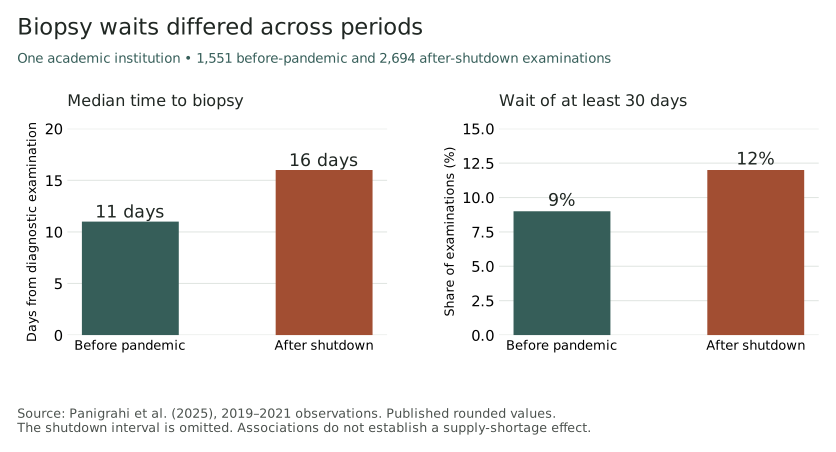
One multisite academic institution. 2019–2021 observations.
Median time from diagnostic examination to biopsy
Bar scale: 0–20 days.
1,551 before-pandemic and 2,694 after-shutdown examinations. Shutdown interval omitted; reported percentages are rounded.
Original report figure
Navigation can help
A 2025 meta-analysis found improved breast-screening follow-up in three randomized trials involving 1,008 participants: risk ratio 1.23 (95% CI 1.15–1.41).
The evidence has limits
An earlier review found uncertainty and substantial heterogeneity in diagnostic resolution. Neither review tested navigation during a biopsy-device shortage.
Evidence matrix: designs, contributions and limitations
| Source | Design or record | Contribution | Main limitation |
|---|---|---|---|
| FDA and manufacturer notices | Product and supply records | Events, instructions, company recovery statements | No patient-level measure of current harm |
| Kommula et al. 2026 | Operational analysis | Mechanisms of consumable dependency | No causal estimate or intervention trial |
| Lawson et al. 2022 | Multisite observational cohort | Historical access differences | Predates current disruptions |
| Panigrahi et al. 2025 | Retrospective institutional cohort | Timeliness across pandemic periods | Setting and period limit transferability |
| Oluyemi et al. 2024 | Registry analysis | Follow-up timing and documentation | Missing documentation is not proof of absent care |
| Özcan et al. 2023 | Systematic review and meta-analysis | MRI-guided biopsy performance | Selected studies and metric-specific exclusions |
| Nelson et al. 2025 | Meta-analysis of randomized trials | Support for navigation in follow-up | Only three breast follow-up trials |
| Tian et al. 2022 | Meta-analysis of randomized trials | Qualified navigation evidence | Substantial heterogeneity; uncertain resolution effect |
Author's evidence appraisal. This matrix is not a formal risk-of-bias assessment. None of these studies quantifies patient harm from the current product events.
An original operational synthesis
Keep responsibility connected to the patient.
Five management actions connect verified capacity to a completed and explained diagnostic episode.
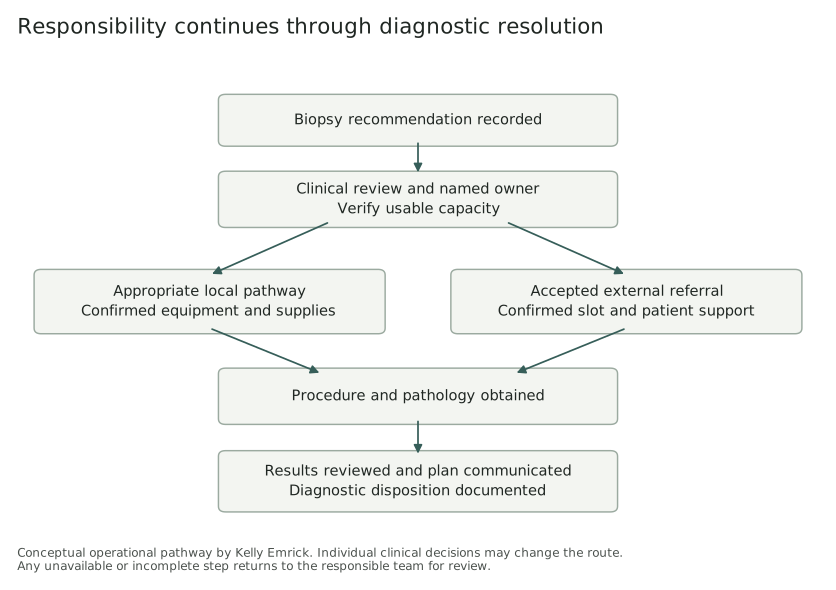
Establish the actual capacity of the service
The operations leader and supply-chain team should begin with a physical reconciliation of usable inventory by site, product, lot status, expiry, and approved compatibility. Recalled or otherwise unavailable units must be excluded from usable stock. Supplier orders should be separated into requested, confirmed, shipped, and received quantities. Treating all open orders as future supply creates false confidence.
Capacity should then be matched to the expected procedure mix. A count of boxes is insufficient if the available products cannot support the scheduled cases. The planning record should show which procedures the remaining stock can support, the staffing and equipment required, and the uncertainty in replenishment. A dated inventory snapshot allows clinical leaders to make decisions using the same information.
A forecast should include more than one demand and delivery assumption. Leaders can examine the consequences of a longer lead time, a higher referral volume, or a partially filled shipment without assigning unsupported probabilities. Each scenario should name the operational action it would trigger. This turns uncertainty into a decision process rather than an optimistic delivery estimate.
Give every affected episode a responsible clinician and coordinator
The breast imaging medical director should oversee clinical review of potentially affected cases. The review should establish the next appropriate action, its clinical rationale, the person authorized to revise it, and an individualized review or completion date. Operations staff should not independently substitute a different clinical pathway to solve a supply problem.
A named coordinator should maintain contact and verify that the plan can be executed. The clinician owns clinical decisions; the coordinator owns the agreed communication and follow-up tasks. Their responsibilities should be visible to each other. When no appropriate appointment is available, the issue should move to a leader with authority over resources and external arrangements.
The decision record should preserve both the original plan and subsequent revisions. If an interval changes because of clinical reassessment, that should be documented separately from a change caused by capacity. The distinction protects clinical reasoning and enables an honest assessment of operational delay.
Verify alternatives before presenting them as solutions
An alternate local route should be checked for clinical appropriateness, approved equipment and supplies, operator competence, and staffing. A receiving center should confirm that it can accept the specific procedure. Transfer arrangements should identify who obtains authorization, sends images, provides instructions, and confirms the result.
The patient should receive a practical plan with a contact and the next expected communication. If transportation, language, financial questions, or other barriers emerge, the coordinator should document them and connect the patient to available support. A failed transfer should return to active review rather than disappearing into a closed referral queue.
Shared regional arrangements may be especially valuable for lower-volume sites. They should specify how urgent requests are reviewed, what happens when the receiving center reaches capacity, and how information returns to the original team. Periodic exercises using hypothetical cases can reveal missing steps before a real patient depends on the arrangement.
Measure through the diagnostic endpoint
The registry should continue beyond the biopsy date until the responsible team has reviewed the result and communicated the plan. This proposed definition does not require that every patient receive a benign result or finish cancer treatment. It requires a documented diagnostic disposition and ownership of whatever comes next.
Daily review during active disruption should focus on unresolved episodes approaching their clinician-selected review dates, unaccepted referrals, and newly unavailable capacity. Weekly review should consider trends, workload, and disparities. An executive sponsor should receive exceptions that the clinical and operational teams cannot resolve with their delegated resources.
The dashboard should show counts as well as rates. A small denominator can make a rate fluctuate sharply. The report should identify patients still waiting, rather than limiting analysis to the subset who reached a procedure. A fall in cancellations is not evidence of recovery if affected cases were never placed on the schedule.
Fund continuity and reassess it after supply returns
The response requires protected staff time. Budget categories include inventory verification, navigation, scheduling, training, equipment or service agreements, courier and record transfer, interpreter services, and approved patient-support resources. Costs should be assigned to the party that bears them. A hospital's savings should not be presumed to represent a patient's savings.
An incremental budget compares the proposed response with existing resources, avoiding double-counting staff already funded for the same work. Sensitivity analysis should vary local workload, time per case, supply cost, and delivery uncertainty. Any projected savings from avoided cancellations or repeated work should be labeled estimates. This report makes no return-on-investment claim for the proposed framework.
Restored shipments should trigger a reconciliation of the outstanding patient list. Recovery is incomplete if stock has returned while unresolved episodes remain. The final review should identify what failed, what worked, which temporary arrangements should become permanent, and how future capital and purchasing decisions will incorporate service continuity.
From insight to action
Make continuity visible.
Use the checklist, scenario calculator and metric definitions to structure a local leadership discussion.
Continuity action checklist
0 of 10A planning aid, not a validated readiness score. Checkmarks stay in this browser when storage is available.
Scenario calculator
How long does usable supply cover demand?
Use verified inventory for one compatible product and approved use. Exclude recalled units and unconfirmed orders.
Modeled supply coverage
8 days4 days of modeled demand beyond coverage.
Illustrative defaults. Coverage = usable units ÷ daily use. The gap compares that coverage with your replenishment assumption; it does not confirm a delivery date or determine clinical urgency.
Measures that preserve the patient journey
Expand each measure for its owner, definition, and interpretation. Report counts and missing information alongside rates.
Usable supply coverage
Owner: Supply-chain lead
Definition
Verified usable units divided by forecast units consumed per day, separately by product and approved use
Review and interpretation
Daily during disruption. If projected use is zero, report not applicable; exclude unconfirmed orders.
Supply-attributed postponement
Owner: Operations lead
Definition
Episodes with a planned procedure moved later because required supply was unavailable / episodes planned in the period
Review and interpretation
Weekly count and percentage. Preserve first date and include additional contributing reasons.
Completion by clinical due date
Owner: Medical director
Definition
Episodes completed by their documented due date / eligible episodes due in the period
Review and interpretation
Weekly. Report missing due dates and approved exclusions separately; no universal deadline implied.
Unresolved case aging
Owner: Navigator
Definition
Calendar days since recommendation for every still-open diagnostic episode
Review and interpretation
Daily exceptions; weekly distribution. Include unscheduled cases and transfers.
External referral completion
Owner: Referral coordinator
Definition
Confirmed completed external procedures / all accepted external procedure referrals in a defined cohort
Review and interpretation
Weekly with follow-up maturity shown. Do not exclude pending cases to improve the rate.
Diagnostic closure
Owner: Clinical lead
Definition
Episodes with reviewed results and a communicated next plan / episodes expected to reach that stage
Review and interpretation
Weekly cohort review. Report the stage reached and remaining handoff.
Data completeness
Owner: Analyst
Definition
Episodes with all required dates, status, reason codes and ownership / active episodes
Review and interpretation
Weekly audit; missing values remain missing. Review a sample against source records.
View the complete metric dictionary
| Measure and owner | Definition | Review and interpretation |
|---|---|---|
| Usable supply coverage Supply-chain lead | Verified usable units divided by forecast units consumed per day, separately by product and approved use | Daily during disruption. If projected use is zero, report not applicable; exclude unconfirmed orders. |
| Supply-attributed postponement Operations lead | Episodes with a planned procedure moved later because required supply was unavailable / episodes planned in the period | Weekly count and percentage. Preserve first date and include additional contributing reasons. |
| Completion by clinical due date Medical director | Episodes completed by their documented due date / eligible episodes due in the period | Weekly. Report missing due dates and approved exclusions separately; no universal deadline implied. |
| Unresolved case aging Navigator | Calendar days since recommendation for every still-open diagnostic episode | Daily exceptions; weekly distribution. Include unscheduled cases and transfers. |
| External referral completion Referral coordinator | Confirmed completed external procedures / all accepted external procedure referrals in a defined cohort | Weekly with follow-up maturity shown. Do not exclude pending cases to improve the rate. |
| Diagnostic closure Clinical lead | Episodes with reviewed results and a communicated next plan / episodes expected to reach that stage | Weekly cohort review. Report the stage reached and remaining handoff. |
| Data completeness Analyst | Episodes with all required dates, status, reason codes and ownership / active episodes | Weekly audit; missing values remain missing. Review a sample against source records. |
Original proposals, not validated performance standards. Use a documented local baseline, clinically determined dates, and predefined cohort rules. Stratify when numbers and privacy permit.
Implementation and escalation
These are proposed management intervals. Immediate clinical needs take precedence, and work may need to occur concurrently.
First 48 hoursOperations and supply-chain leads
Reconciled inventory and affected-case list; escalate unverified stock or a case without a safe executable plan.
First weekMedical director and navigation lead
Individual decisions, assigned coordinators, accepted alternative pathways; escalate unresolved capacity barriers.
Weeks 2 to 4Executive sponsor and analyst
Baseline, metric definitions, funded coordination, tested referral arrangements; resolve cross-department constraints.
During disruptionClinical and operations leads
Daily case exceptions and weekly trend review; revise scenarios when demand or delivery changes.
After supply recoveryExecutive sponsor
Backlog reconciliation, documented learning, durable purchasing and continuity changes; keep unresolved cases active.
What a deeper investigation would need to establish
| Question | Records needed | Interpretation safeguard |
|---|---|---|
| Which cases were affected? | Product-specific inventory; recommended and scheduled procedure logs | Preserve original appointments and unscheduled cases |
| Was care postponed? | Reason-coded changes; actual procedure dates; clinical review notes | Separate supply causes from other barriers |
| Did a referral work? | Acceptance, appointment, completion, result return | Do not equate referral submission with completion |
| Was the burden unequal? | Waits and completion by site and patient characteristics | Protect small groups and report missingness |
| Was recovery achieved? | Received stock; backlog disposition; replenishment reliability | Distinguish shipments from restored service capacity |
Original reporting agenda. These are proposed evidence requests, not records obtained or findings established by this report.
The full report
Read beyond the headline.
The complete narrative and original report elements are available here, with expandable sections for easier reading.
Executive abstract
The United States is confronting overlapping disruptions in breast biopsy supplies. An established shortage involving stereotactic biopsy needles has been followed by a manufacturing hold affecting ATEC needles used in MRI and other image-guided procedures. Public notices establish the product actions and anticipated supply constraints. They do not establish how many patients have experienced diagnostic delay or suffered a resulting adverse outcome. This documentary investigation examines that distinction, the operational dependence of diagnostic services on specialized consumables, and the accountability required when supplies fail.
The central finding is a gap between knowledge of a supply disruption and evidence of its consequences for patients. Device notices describe products and recovery plans; published studies describe longstanding barriers to diagnostic completion. Connecting those bodies of evidence requires patient-level tracking of affected procedures, clinically justified alternatives, completed referrals, and final diagnostic resolution. Existing research supports concern about unequal access and offers qualified support for navigation, but it cannot quantify harm from these specific shortages.
The report proposes a practical continuity framework for imaging leaders, purchasing teams, referring clinicians, and governing boards. It combines verified inventory, individual clinical review, executable backup arrangements, patient navigation, and measurement through diagnostic completion. The framework is an original operational synthesis, not a validated clinical protocol. Its purpose is to make responsibility visible and prevent a supply problem from becoming an unobserved interruption in care.
Reporting scope and reading guide
This report is a documentary investigation and critical research synthesis based on public records available through November 11, 2026. Sources include FDA records, manufacturer statements, American College of Radiology guidance, and peer-reviewed research. No original patient interviews, confidential hospital records, or unpublished national outcome dataset were available for this report. Manufacturer statements are attributed; operational recommendations are identified as the author's analysis. The investigation does not establish negligence, a national tally of affected patients, or a causal link between the shortages and cancer progression.
The first sections reconstruct the events and examine the diagnostic consequences that require investigation. Later sections provide an implementation and measurement framework. An evidence matrix, reporting agenda, and linked APA references allow readers to inspect the foundation of the argument. Clinical decisions remain individualized and belong to the treating team.
A warning at the point of diagnosis
On October 20, 2026, Hologic placed ATEC breast biopsy needles on a temporary manufacturing hold. The company's November 2 update attributed the decision to an internal manufacturing-process defect requiring investigation. It said existing ATEC inventory could continue to be used under approved labeling and instructions, and promised another availability update by November 30 (Hologic, 2026a).
For a patient awaiting clarification of a suspicious breast finding, the practical question is whether the next necessary procedure can happen. A manufacturer can identify a problem, pause production, and investigate it. A clinical service must translate that event into a safe plan for every person whose appointment depends on the affected product. The two responsibilities meet at the schedule, but the patient's experience continues well beyond it.
The American College of Radiology's October 30 notice described a shortage of MRI breast biopsy needles and reported that Hologic did not anticipate resuming ATEC supply before early 2027. The estimate was provisional. The college urged clinicians to coordinate care and communicate delays transparently (American College of Radiology [ACR], 2026b).
Those statements establish a substantial operational challenge. They leave unanswered a more consequential question: which patients will encounter a longer wait, a more complicated journey, or a change in their diagnostic plan? A supply announcement cannot answer that question. Neither can a hospital's assurance that it is monitoring the situation. The answer requires following affected patients through the decisions and handoffs that come next.
That is the accountability issue at the center of this investigation. A breast imaging program may have a working scanner, an experienced radiologist, and an appointment on the calendar while lacking the specific consumable needed to complete the planned biopsy. The resulting loss of capacity can be difficult to see in conventional equipment reports. A machine remains operational even when a necessary service is constrained.
The phrase missing needle describes this dependency. It does not mean every breast biopsy service has stopped or every patient faces delay. Local stock, equipment compatibility, clinical alternatives, and regional capacity vary. An honest account must make those differences visible.
Two product events and several different clocks
The earlier Brevera event has a longer history than its 2026 public notices suggest. FDA recall record Z-1314-2026 lists December 15, 2025, as the firm's initiation date, January 2, 2026, as the date of the mailed removal notice, and February 6 as the public posting date. It identifies all lots within expiry of the specified disposable 9-gauge needle and describes particulate material that could enter breast tissue during use. The record lists 681,870 units in commerce (U.S. Food and Drug Administration [FDA], 2026a).
That quantity is a product-distribution figure. It is not a count of patients exposed, procedures canceled, injuries, or delayed cancer diagnoses. Converting it into any of those measures would require information that the recall entry does not provide. The distinction is essential because a large device count can easily become an alarming but inaccurate patient headline.
In June, the FDA described interruptions in the supply of stereotactic breast biopsy needles and anticipated that the shortage could last through March 2027. Its notice explained the concern about particles dislodging from the Brevera device and the possibility of tissue injury or specimen contamination. The agency advised providers experiencing supply interruptions to develop conservation and coordination strategies using clinical judgment (FDA, 2026b).
The ATEC manufacturing hold is a different event. Its November notice permits continued use of existing inventory under the approved instructions. That statement must not be carried backward to the recalled Brevera needles, which were subject to removal instructions. Nor should the Brevera particulate concern be assigned to ATEC without supporting documentation.
| Date | Record | What it establishes |
|---|---|---|
| Dec 15 2025 | FDA Brevera recall entry | Firm initiation date; separate from customer notification and public posting. |
| Jan 2 2026 | Brevera removal notice | Notice mailed to customers; affected devices were to be quarantined and returned. |
| Feb 6 2026 | FDA recall posting | Public posting of Class II recall Z-1314-2026. |
| Jun 16 2026 | FDA provider letter | Stereotactic needle supply disruption; estimated duration through March 2027. |
| Aug 2026 | Hologic Brevera update | Reported 510(k) clearance; year-end return-to-market target. |
| Aug 26 2026 | Mammotome announcement | Company reported capacity expansion for stereotactic biopsy products. |
| Oct 20 2026 | ATEC manufacturing hold | Effective date reported in Hologic's November 2 update. |
| Oct 30 2026 | ACR MRI shortage guidance | ATEC resupply not anticipated before early 2027; estimate subject to change. |
| Nov 2 2026 | Hologic ATEC update | Existing inventory may be used under approved instructions; next update expected by November 30. |
Sources: FDA (2026a, 2026b); Hologic (2026a, 2026b); Mammotome (2026); ACR (2026b). Recovery estimates are not confirmed delivery dates.
The recovery dates also refer to different things. In an August update, Hologic reported FDA 510(k) clearance for the Brevera 9G needle and a target of returning Brevera to market by the end of 2026. The company also described increasing Eviva needle production and enabling use of the Brevera system for standalone specimen imaging (Hologic, 2026b). Separately, the FDA shortage list continued to estimate a stereotactic needle shortage through the first quarter of 2027 (FDA, 2026c).
A regulatory milestone, a product relaunch target, and a market-wide availability estimate can differ without necessarily contradicting one another. Clearance does not establish how many units have reached each clinical site. A return to market does not establish that accumulated orders or deferred procedures have been completed. The operational recovery date is the point at which the service can reliably meet clinical need, including any backlog. That date requires evidence from providers as well as suppliers.
There is also evidence of a competitive response. On August 26, Mammotome announced expanded manufacturing capacity and support for providers using its stereotactic biopsy platform. That announcement documents the company's stated response; it does not independently establish the amount of unmet demand eliminated or the geographic availability of appointments (Mammotome, 2026).
The ACR's guidance updated in August had already noted that limited alternatives had not fully met clinical demand (ACR, 2026a). The public record therefore supports a more precise account than a single shortage headline. There are distinct devices, different safety instructions, several recovery milestones, and uncertain effects across local services.
The dependency hidden inside a diagnostic service
Kommula and colleagues (2026) describe breast biopsy consumables as a concentrated market in which proprietary devices can create dependence on particular platforms. Their analysis considers inventory reserves, vendor diversification, and standardization across networks as complementary strategies. It is an operational examination of vulnerability, not an empirical estimate of harm from the current disruptions.
The implication is straightforward but easily missed in capital planning: purchasing a biopsy system also creates a continuing relationship with the supplies, competencies, maintenance, and workflows that make it usable. A procurement comparison that focuses on acquisition price or routine unit cost can leave interruption risk largely unexamined.
This report's operational interpretation is that a backup must be defined as a deliverable service. A second supplier's contact information is only the beginning. Leaders need to establish what equipment the alternative requires, whether the team is competent to use it, whether the needed products can actually be obtained, and how the alternative fits the patient's clinical needs. The availability of a different needle somewhere in the market does not establish that it can be used on a particular installed system.
The same scrutiny applies to regional referral arrangements. An agreement to accept referrals does not necessarily include reserved appointments, confirmed inventory, timely image transfer, or insurance authorization support. If neighboring centers experience the same demand surge, an arrangement that worked in a routine week may not provide capacity during a regional disruption.
There are legitimate tradeoffs. Additional platforms cost money, require training, and can complicate standard work. Larger reserves consume space and tie up capital; unused products may expire. Smaller community sites may lack the procedural volume needed to support parallel systems. An effective investigation should examine how those tradeoffs were evaluated, rather than assuming every organization should buy duplicate equipment.
The governing question is whether the chosen arrangement has been tested against a plausible interruption. A regional network might provide stronger continuity through shared inventory and an equipped referral center than through duplication at every location. That approach is defensible only if patients can reach the receiving service and the transfer can occur within a clinically appropriate interval.
The image is not the diagnosis
MRI can reveal suspicious findings that are not visible on other imaging modalities. A 2023 systematic review by Özcan and colleagues examined MRI-guided biopsy performance across 50 articles involving 11,215 lesions. It reported a pooled technical success rate of 99.10%, with a 95% confidence interval of 97.89% to 99.62%; procedures canceled for nonenhancement were excluded from that technical-success analysis. The review supports the established diagnostic value of MRI-guided sampling under the conditions studied. It does not show that another modality is an equivalent substitute for every MRI-detected finding (Özcan et al., 2023).
The clinical distinction matters to the public story. A suspicious finding is not a confirmed malignancy, and a recommendation for biopsy does not predetermine the result. The purpose of tissue sampling is to clarify uncertainty. Reporting that describes all patients awaiting biopsy as patients with undiagnosed cancer would misrepresent both the process and the people affected.
A clinician may identify an appropriate alternative route for some patients. For others, the original method may remain necessary. The decision depends on the finding, its visibility, the clinical question, prior results, and the patient's circumstances. The ACR includes alternative imaging guidance and clinical prioritization among possible responses, with explicit qualifications about feasibility and individual circumstances (ACR, 2026b).
Resource availability should be recorded separately from clinical assessment. A supply problem may change how a service delivers a justified diagnostic plan; it should not become an undocumented reason to relabel the finding. When a plan changes, the record should explain the clinical basis, the responsible clinician, and the next review point. This is an accountability recommendation, not a substitute for professional judgment.
The endpoint also deserves precision. Completing a biopsy does not automatically complete the diagnostic episode. Pathology must be available, the imaging and pathology findings must be assessed together when appropriate, and the patient and referring clinician must receive the resulting plan. A shortage response that stops counting at the procedure can overlook the remaining handoffs.
What earlier research can tell us about waiting
The most useful research establishes the conditions into which the supply disruptions have arrived. It cannot measure the consequences of events that occurred after its data were collected.
Lawson and colleagues (2022) studied 45,186 women with 46,185 abnormal screening examinations and biopsy recommendations. In that cohort, 34.6% of examinations were not resolved by biopsy or aspiration within 30 days, 16.2% within 60 days, and 12.2% within 90 days. Black women remained at greater risk of no biopsy within 90 days after adjustment for measured factors, including screening facility. These results describe historical diagnostic access, not current shortage-attributable delay.
Panigrahi and colleagues (2025) examined 4,415 examinations among 4,197 patients at a multisite academic institution during 2019–2021. Median time from diagnostic examination to biopsy increased from 11 days before the pandemic to 16 days after the shutdown period. The proportion waiting at least 30 days increased from 9% to 12%. Those findings show that timeliness can remain disrupted after an acute event, but their observational design does not isolate a single cause or predict the magnitude of a device shortage's effect.
A separate National Mammography Database analysis reported a median interval of 21 days from diagnostic evaluation to biopsy among documented follow-up, with differences across demographic and facility characteristics. It also identified incomplete documentation of follow-up (Oluyemi et al., 2024). Missing registry documentation cannot automatically be interpreted as care never occurring. Some care may take place elsewhere or fail to appear in the reporting system.
These studies use different populations, starting points, and outcome definitions. The intervals from screening to biopsy and from diagnostic examination to biopsy are not interchangeable. Placing their results into one pooled ranking would imply comparability that has not been established. Likewise, a threshold used to analyze delay is not a universal clinical declaration that waiting until that day is safe.
The appropriate inference is narrower and more useful: access already involves multiple vulnerable transitions, and a supply disruption could add another barrier. The question is which transitions change, for whom, and by how much. That requires contemporary local data.
An organization should therefore resist evaluating the shortage solely through a monthly average. If completed procedures remain timely while a smaller group accumulates unresolved appointments, the average among completed cases may appear reassuring. The patients who have not yet reached the procedure are precisely the people a continuity dashboard must retain.
An uneven burden is a question to measure
The historical disparities described above make equity an essential part of the investigation. They do not establish that this shortage has already produced a particular racial, financial, or geographic disparity. That distinction protects the credibility of the article and identifies the measurement work still needed.
Consider a clearly hypothetical situation: two patients need an equivalent procedure and both are offered an appointment at a distant center. One can take time off, arrange transportation, and transfer records quickly. The other needs an interpreter, has limited transportation, and cannot absorb an unexpected day away from work. The referral offer is the same; the ability to complete it differs. This example illustrates a mechanism to examine, not a reported patient case.
To test that mechanism, a provider would need to measure the time between referral and accepted appointment, whether the appointment was completed, and the reasons for any remaining barrier. Useful segmentation could include site, modality, insurance category, preferred language, distance, and voluntarily reported demographic characteristics. Small groups require privacy protection and cautious interpretation. Missing information should be visible rather than silently assigned to a favorable category.
Patient communication should also be examined as an operational intervention. Telling someone that a procedure is unavailable provides information. Helping that person obtain a clinically appropriate alternative requires staff time, decision authority, and access to receiving services. The latter is the service patients need when the usual route fails.
There is evidence for navigation, although its scope should be represented honestly. Nelson and colleagues (2025) found improved follow-up after abnormal breast screening in a meta-analysis of three randomized trials involving 1,008 participants, with a risk ratio of 1.23 and a 95% confidence interval of 1.15 to 1.41. These trials formed a small part of a much larger review of screening and follow-up services. They did not test navigation during a biopsy-device shortage.
An earlier review reached a less definitive conclusion about diagnostic resolution. Tian and colleagues (2022) reported an estimate favoring navigation whose confidence interval included no effect, along with substantial heterogeneity. It also found shorter time to resolution, again with high heterogeneity. Differences in included trials, interventions, populations, and endpoints limit direct comparison between reviews.
The practical interpretation is to fund navigation while evaluating its actual contribution. It may help patients cross administrative and logistical barriers. It cannot create sterile supplies or an appropriately staffed procedure slot where none exists. A navigator should have a route for escalating capacity problems, not simply be held responsible for resolving them through persistence.
What the public record establishes and leaves open
The records reviewed establish product-specific actions, professional mitigation guidance, and manufacturer recovery statements. They also establish that timeliness and follow-up were uneven before these events. Together, they justify careful investigation of diagnostic continuity.
They do not supply a national patient-level denominator for the current disruptions. The report therefore cannot calculate the proportion of affected patients whose biopsies were postponed, the average additional wait, or the number whose treatment changed because of the shortage. It cannot infer cancer progression or deaths from product counts or historical delay studies.
The FDA itself cautions that inclusion of a device category on its shortage list does not necessarily establish that patient care has been affected (FDA, 2026c). The list is an important warning and transparency mechanism. It is not a complete account of each provider's remaining stock, clinical capacity, or outcomes.
Nor does a voluntary manufacturing hold, by itself, establish wrongdoing. A company may need to stop production to investigate quality concerns. The questions for accountability concern the adequacy and timing of detection, communication, correction, and continuity support. Answers would require detailed records beyond the public notices reviewed here.
The same standard applies to providers. A postponed appointment can have several causes: supply availability, clinical reassessment, illness, scheduling constraints, insurance processes, or patient preference. Investigators should preserve those distinctions and examine interactions between them. Coding every delayed case as a supply failure would exaggerate the effect; recording every transfer as a successful resolution could conceal it.
| Source | Design or record | Contribution | Main limitation |
|---|---|---|---|
| FDA and manufacturer notices | Product and supply records | Events, instructions, company recovery statements | No patient-level measure of current harm |
| Kommula et al. 2026 | Operational analysis | Mechanisms of consumable dependency | No causal estimate or intervention trial |
| Lawson et al. 2022 | Multisite observational cohort | Historical access differences | Predates current disruptions |
| Panigrahi et al. 2025 | Retrospective institutional cohort | Timeliness across pandemic periods | Setting and period limit transferability |
| Oluyemi et al. 2024 | Registry analysis | Follow-up timing and documentation | Missing documentation is not proof of absent care |
| Özcan et al. 2023 | Systematic review and meta-analysis | MRI-guided biopsy performance | Selected studies and metric-specific exclusions |
| Nelson et al. 2025 | Meta-analysis of randomized trials | Support for navigation in follow-up | Only three breast follow-up trials |
| Tian et al. 2022 | Meta-analysis of randomized trials | Qualified navigation evidence | Substantial heterogeneity; uncertain resolution effect |
Author's evidence appraisal. This matrix is not a formal risk-of-bias assessment. None of these studies quantifies patient harm from the current product events.
The records needed for a deeper investigation
The next stage of accountability should connect the device event to the individual diagnostic episode. A useful reporting unit is the recommended procedure associated with a finding, linked to the patient and the eventual disposition. Counting only encounters can double-count rescheduled visits or lose the connection between an original recommendation and a procedure completed elsewhere.
For each affected episode, a provider should be able to identify the recommendation date, intended modality, original appointment, actual procedure date, clinical urgency, and reason for any change. The original appointment must remain available after rescheduling. Otherwise, the schedule can erase the very delay an analyst is trying to measure.
External referrals require additional evidence: acceptance by the receiving center, an appointment date, transfer of necessary records, completion confirmation, and return of the diagnostic plan. Where records cannot be obtained, the episode should remain unresolved in the analysis. Administrative closure and clinical resolution are different events.
| Question | Records needed | Interpretation safeguard |
|---|---|---|
| Which cases were affected? | Product-specific inventory; recommended and scheduled procedure logs | Preserve original appointments and unscheduled cases |
| Was care postponed? | Reason-coded changes; actual procedure dates; clinical review notes | Separate supply causes from other barriers |
| Did a referral work? | Acceptance, appointment, completion, result return | Do not equate referral submission with completion |
| Was the burden unequal? | Waits and completion by site and patient characteristics | Protect small groups and report missingness |
| Was recovery achieved? | Received stock; backlog disposition; replenishment reliability | Distinguish shipments from restored service capacity |
Original reporting agenda. These are proposed evidence requests, not records obtained or findings established by this report.
Manufacturers should have an opportunity to explain quality-control findings, correction milestones, allocation decisions, and the limits of projected availability. Providers should be asked to explain their contingency arrangements and any constraints on sharing data. Patients who choose to share their experiences should be asked about the entire sequence, with dates and documents used to corroborate events when possible. None of those interviews is represented as having occurred in this report.
A national investigation would also need a sampling strategy. A convenience sample of unusually disrupted centers could overstate prevalence; a sample composed only of large systems could miss community-service constraints. Including sites with different platforms and stable supply could help distinguish general scheduling pressure from product-related disruption. Even then, observed differences would need adjustment for case mix and local changes.
The strongest public-interest finding might be a failure, a successful response, or substantial variation. The reporting process should allow any of those conclusions. Its purpose is to determine what happened and what can be improved, rather than to fit every organization into a predetermined narrative.
A proposed framework for maintaining diagnostic continuity
The following framework is the author's operational synthesis. It draws on the source documents and research while extending them into an implementable management approach. It has not been prospectively validated. Its proposed review routines and timing are management choices that require local adaptation; they are not universal clinical deadlines.
Establish the actual capacity of the service
The operations leader and supply-chain team should begin with a physical reconciliation of usable inventory by site, product, lot status, expiry, and approved compatibility. Recalled or otherwise unavailable units must be excluded from usable stock. Supplier orders should be separated into requested, confirmed, shipped, and received quantities. Treating all open orders as future supply creates false confidence.
Capacity should then be matched to the expected procedure mix. A count of boxes is insufficient if the available products cannot support the scheduled cases. The planning record should show which procedures the remaining stock can support, the staffing and equipment required, and the uncertainty in replenishment. A dated inventory snapshot allows clinical leaders to make decisions using the same information.
A forecast should include more than one demand and delivery assumption. Leaders can examine the consequences of a longer lead time, a higher referral volume, or a partially filled shipment without assigning unsupported probabilities. Each scenario should name the operational action it would trigger. This turns uncertainty into a decision process rather than an optimistic delivery estimate.
Give every affected episode a responsible clinician and coordinator
The breast imaging medical director should oversee clinical review of potentially affected cases. The review should establish the next appropriate action, its clinical rationale, the person authorized to revise it, and an individualized review or completion date. Operations staff should not independently substitute a different clinical pathway to solve a supply problem.
A named coordinator should maintain contact and verify that the plan can be executed. The clinician owns clinical decisions; the coordinator owns the agreed communication and follow-up tasks. Their responsibilities should be visible to each other. When no appropriate appointment is available, the issue should move to a leader with authority over resources and external arrangements.
The decision record should preserve both the original plan and subsequent revisions. If an interval changes because of clinical reassessment, that should be documented separately from a change caused by capacity. The distinction protects clinical reasoning and enables an honest assessment of operational delay.
Verify alternatives before presenting them as solutions
An alternate local route should be checked for clinical appropriateness, approved equipment and supplies, operator competence, and staffing. A receiving center should confirm that it can accept the specific procedure. Transfer arrangements should identify who obtains authorization, sends images, provides instructions, and confirms the result.
The patient should receive a practical plan with a contact and the next expected communication. If transportation, language, financial questions, or other barriers emerge, the coordinator should document them and connect the patient to available support. A failed transfer should return to active review rather than disappearing into a closed referral queue.
Shared regional arrangements may be especially valuable for lower-volume sites. They should specify how urgent requests are reviewed, what happens when the receiving center reaches capacity, and how information returns to the original team. Periodic exercises using hypothetical cases can reveal missing steps before a real patient depends on the arrangement.
Measure through the diagnostic endpoint
The registry should continue beyond the biopsy date until the responsible team has reviewed the result and communicated the plan. This proposed definition does not require that every patient receive a benign result or finish cancer treatment. It requires a documented diagnostic disposition and ownership of whatever comes next.
Daily review during active disruption should focus on unresolved episodes approaching their clinician-selected review dates, unaccepted referrals, and newly unavailable capacity. Weekly review should consider trends, workload, and disparities. An executive sponsor should receive exceptions that the clinical and operational teams cannot resolve with their delegated resources.
The dashboard should show counts as well as rates. A small denominator can make a rate fluctuate sharply. The report should identify patients still waiting, rather than limiting analysis to the subset who reached a procedure. A fall in cancellations is not evidence of recovery if affected cases were never placed on the schedule.
Fund continuity and reassess it after supply returns
The response requires protected staff time. Budget categories include inventory verification, navigation, scheduling, training, equipment or service agreements, courier and record transfer, interpreter services, and approved patient-support resources. Costs should be assigned to the party that bears them. A hospital's savings should not be presumed to represent a patient's savings.
An incremental budget compares the proposed response with existing resources, avoiding double-counting staff already funded for the same work. Sensitivity analysis should vary local workload, time per case, supply cost, and delivery uncertainty. Any projected savings from avoided cancellations or repeated work should be labeled estimates. This report makes no return-on-investment claim for the proposed framework.
Restored shipments should trigger a reconciliation of the outstanding patient list. Recovery is incomplete if stock has returned while unresolved episodes remain. The final review should identify what failed, what worked, which temporary arrangements should become permanent, and how future capital and purchasing decisions will incorporate service continuity.
Measuring the effect without manufacturing certainty
The metric dictionary below offers a starting point. Each organization should preserve its baseline, approve definitions before interpreting change, and document changes in data collection. The goal is to make the diagnostic process inspectable without converting uncertain records into false precision.
| Measure and owner | Definition | Review and interpretation |
|---|---|---|
| Usable supply coverage Supply-chain lead | Verified usable units divided by forecast units consumed per day, separately by product and approved use | Daily during disruption. If projected use is zero, report not applicable; exclude unconfirmed orders. |
| Supply-attributed postponement Operations lead | Episodes with a planned procedure moved later because required supply was unavailable / episodes planned in the period | Weekly count and percentage. Preserve first date and include additional contributing reasons. |
| Completion by clinical due date Medical director | Episodes completed by their documented due date / eligible episodes due in the period | Weekly. Report missing due dates and approved exclusions separately; no universal deadline implied. |
| Unresolved case aging Navigator | Calendar days since recommendation for every still-open diagnostic episode | Daily exceptions; weekly distribution. Include unscheduled cases and transfers. |
| External referral completion Referral coordinator | Confirmed completed external procedures / all accepted external procedure referrals in a defined cohort | Weekly with follow-up maturity shown. Do not exclude pending cases to improve the rate. |
| Diagnostic closure Clinical lead | Episodes with reviewed results and a communicated next plan / episodes expected to reach that stage | Weekly cohort review. Report the stage reached and remaining handoff. |
| Data completeness Analyst | Episodes with all required dates, status, reason codes and ownership / active episodes | Weekly audit; missing values remain missing. Review a sample against source records. |
Original proposals, not validated performance standards. Use a documented local baseline, clinically determined dates, and predefined cohort rules. Stratify when numbers and privacy permit.
The recommended primary operational outcome is completion by an individualized, documented clinical due date among episodes due during the reporting period. A lack of a due date is a data-quality problem to report separately, not an automatic success. An episode clinically rescinded before the due date may be excluded under a predefined rule, but the count and reason should remain visible.
For analytic comparisons, the organization should retain intervals from the original recommendation and from the first planned procedure date. It should distinguish supply-attributed postponement from the total elapsed time. If several barriers contribute, a primary reason and additional reasons can be recorded, with a periodic chart audit to assess consistency.
Before-and-after comparisons are vulnerable to changes in volume, referral patterns, staffing, case severity, and data completeness. A time series can reveal patterns more clearly than two isolated monthly averages. Where feasible, a comparator service with unaffected supply may help interpretation, provided differences in clinical populations and timing are considered. Neither design alone proves that an observed outcome was caused by the shortage or by the response framework.
Clinical outcomes require additional care. Stage at diagnosis is influenced by tumor biology, prior screening, symptom history, and multiple access factors. Attributing a later stage to a particular supply event would require a clinically and methodologically defensible analysis. The same caution applies more strongly to mortality. The present report supports better measurement of continuity; it does not offer a model for estimating deaths from missing needles.
Implementation and sustained accountability
An executive sponsor should authorize the cross-functional work and resolve constraints that exceed departmental authority. The breast imaging medical director should lead clinical decisions. An operations lead should integrate staffing, equipment, schedules, and inventory. Supply-chain staff should reconcile product status and supplier commitments. A navigator or designated coordinator should track patient transitions. An analyst should maintain definitions and flag incomplete records.
These responsibilities can be assigned to existing positions, but they still consume time. A staffing plan should estimate the active caseload, contact frequency, time needed for external coordination, and coverage during absence. Assigning a responsibility without protected capacity creates an apparent control that may not function under pressure.
| Management interval | Accountable lead | Required output and escalation |
|---|---|---|
| First 48 hours | Operations and supply-chain leads | Reconciled inventory and affected-case list; escalate unverified stock or a case without a safe executable plan. |
| First week | Medical director and navigation lead | Individual decisions, assigned coordinators, accepted alternative pathways; escalate unresolved capacity barriers. |
| Weeks 2 to 4 | Executive sponsor and analyst | Baseline, metric definitions, funded coordination, tested referral arrangements; resolve cross-department constraints. |
| During disruption | Clinical and operations leads | Daily case exceptions and weekly trend review; revise scenarios when demand or delivery changes. |
| After supply recovery | Executive sponsor | Backlog reconciliation, documented learning, durable purchasing and continuity changes; keep unresolved cases active. |
Author-proposed management timing, not clinical waiting-time guidance. Immediate clinical needs take precedence; local teams may need to perform activities concurrently.
The proposed sequence begins with an inventory and patient reconciliation, then moves to tested alternatives and ongoing review. Local circumstances may require these activities to overlap. The schedule describes management work, not permission to defer any patient's clinical assessment until a particular week.
Sustainment requires testing for deterioration. Warning signs include growing overdue counts, referrals without acceptance, repeated uncertainty about delivery dates, increasing staff time per case, and gaps between reported inventory and physical stock. A single serious exception may warrant immediate review even when aggregate performance appears stable. The escalation record should show the decision made, the owner, and the date for reassessment.
Governance should also examine incentives. A department measured only on its own completed volume may have little visibility into patients redirected elsewhere. A purchasing team evaluated only on unit price may not be rewarded for maintaining an executable alternative. The remedy is to make diagnostic completion and service continuity shared objectives, with financial measures interpreted alongside access and quality.
The framework can fail if inventory is inaccurate, the registry excludes unscheduled patients, alternatives are listed but untested, or frontline staff cannot obtain decisions. It can also fail by becoming so elaborate that staff spend more time updating reports than coordinating care. Leaders should keep the data set focused, reuse reliable existing records, and reserve detailed review for clinical and operational exceptions.
The obligation after the announcement
The public warnings are substantial. They describe a recalled product, a prolonged shortage, and a later manufacturing hold affecting another biopsy platform. Manufacturers have described corrective work and capacity responses. Professional guidance gives clinical teams options for managing constrained supply. Those are necessary parts of the response.
The remaining obligation is to account for the patient journey. A supply chain can be recovering while a patient remains unresolved. A referral can be sent while no appointment has been accepted. A procedure can be completed while its result has not yet produced a communicated plan. Each difference matters because it marks a place where organizational activity can be mistaken for completed care.
For healthcare leaders, the defensible response is a record of what happened: which cases were affected, what clinical decisions were made, how alternatives were secured, and whether the diagnostic episode reached a documented disposition. Those records would allow the next investigation to measure consequences rather than infer them.
The strongest conclusion supported today is that breast biopsy continuity deserves explicit governance. The precise national effect of these disruptions remains unquantified in the materials reviewed. That uncertainty is a reason to collect better evidence and resolve outstanding care, while keeping public claims proportionate to what the evidence can show.
For the person waiting for an answer, the practical promise is simple: someone remains responsible until the next necessary step is completed and explained.
Methods and limitations
This targeted review followed the product and availability notices into FDA records and manufacturer updates, then examined peer-reviewed literature on biopsy performance, timeliness, disparities, and navigation. It is not a systematic review and does not claim exhaustive retrieval or formal risk-of-bias scoring. Abstracts and accessible full texts were used according to availability; numerical figures are restricted to values explicitly reported in the retrieved sources. No patient-level recalculation was performed.
The two quantitative figures present historical observations, with denominators and definitions kept separate. The pathway diagram and management tables are original conceptual and operational proposals. Illustrations do not depict actual patients, facilities, or reported incidents. Public sources may be revised after the reporting date, and product-specific instructions should be checked against the current applicable notice before operational use.
Manufacturer disclosures are evidence of what those organizations reported, not independent verification of capacity or recovery. The limited availability of contemporary provider outcome data constrains conclusions about the present shortage. The report does not determine legal liability or recommend an individual clinical management plan. Its contribution is to reconstruct documented events, clarify the evidence boundary, and specify how an accountable response can be evaluated.
Evidence and transparency
Inspect the foundation of the argument.
Fifteen linked references distinguish peer-reviewed findings from regulatory and manufacturer records.
15 sources
- Primary record
American College of Radiology. (2026a, August 27). ACR mitigation strategies for breast biopsy needle shortage.
Read source - Primary record
American College of Radiology. (2026b, October 30). ACR offers strategies to address MRI biopsy needle shortage.
Read source - Primary record
Hologic. (2026a, November 2). ATEC breast biopsy needle supply update.
Read source - Primary record
Hologic. (2026b, August). Brevera breast biopsy system: Biopsy needle availability [Product availability update].
Read source - Peer-reviewed research
Kommula, N., Legha, R. S., Mayo, R. C., Le-Petross, H. T., Phalak, K. A., Speer, M. E., Shin, K., & Kalambo, M. (2026). Supply chain vulnerabilities in breast imaging: Site- and network-level strategies for a concentrated consumable market. Journal of the American College of Radiology, 23(9), 1851–1855.
Read source - Peer-reviewed research
Lawson, M. B., Bissell, M. C. S., Miglioretti, D. L., Eavey, J., Chapman, C. H., Mandelblatt, J. S., Onega, T., Henderson, L. M., Rauscher, G. H., Kerlikowske, K., Sprague, B. L., Bowles, E. J. A., Gard, C. C., Parsian, S., & Lee, C. I. (2022). Multilevel factors associated with time to biopsy after abnormal screening mammography results by race and ethnicity. JAMA Oncology, 8(8), 1115–1126.
Read source - Primary record
Mammotome. (2026, August 26). Mammotome accelerates production as public health response to nationwide breast biopsy needle shortage.
Read source - Peer-reviewed research
Nelson, H. D., Cantor, A. G., Pappas, M., Blackie, K., Yu, Y., & Fu, R. (2025). Patient navigation services for breast and cervical cancer screening and follow-up: A meta-analysis. JAMA Internal Medicine, 185(8), 976–985.
Read source - Peer-reviewed research
Oluyemi, E. T., Grimm, L. J., Goldman, L., Burleson, J., Simanowith, M., Yao, K., & Rosenberg, R. D. (2024). Rate and timeliness of diagnostic evaluation and biopsy after recall from screening mammography in the National Mammography Database. Journal of the American College of Radiology, 21(3), 427–438.
Read source - Peer-reviewed research
Özcan, B. B., Yan, J., Xi, Y., Baydoun, S., Scoggins, M. E., & Doğan, B. E. (2023). Performance benchmark metrics and clinicopathologic outcomes of MRI-guided breast biopsies: A systematic review and meta-analysis. European Journal of Breast Health, 19(1), 1–27.
Read source - Peer-reviewed research
Panigrahi, B., Ghuman, N., Rossi, J., Myers, K. S., Mullen, L. A., Ambinder, E. B., & Oluyemi, E. T. (2025). Impact of the COVID-19 pandemic on breast biopsy delays: Factors contributing to disparities across prepandemic, shutdown, and postshutdown periods. Journal of the American College of Radiology, 22(9), 1019–1026.
Read source - Peer-reviewed research
Tian, L., Huang, L., Liu, J., Li, X., Ajmal, A., Ajmal, M., Yao, Y., & Tian, L. (2022). Impact of patient navigation on population-based breast screening: A systematic review and meta-analysis of randomized clinical trials. Journal of General Internal Medicine, 37(11), 2811–2820.
Read source - Primary record
U.S. Food and Drug Administration. (2026a, February 6). Class 2 device recall Brevera biopsy device (Recall Z-1314-2026).
Read source - Primary record
U.S. Food and Drug Administration. (2026b, June 16). Disruptions in availability of breast biopsy needles: Letter to health care providers.
Read source - Primary record
U.S. Food and Drug Administration. (2026c, October 26). Medical device shortages list. Retrieved November 11, 2026, from
Read source
No references match this search. Try a different term or source type.
Methods and limitations
This targeted review followed the product and availability notices into FDA records and manufacturer updates, then examined peer-reviewed literature on biopsy performance, timeliness, disparities, and navigation. It is not a systematic review and does not claim exhaustive retrieval or formal risk-of-bias scoring. Abstracts and accessible full texts were used according to availability; numerical figures are restricted to values explicitly reported in the retrieved sources. No patient-level recalculation was performed.
The two quantitative figures present historical observations, with denominators and definitions kept separate. The pathway diagram and management tables are original conceptual and operational proposals. Illustrations do not depict actual patients, facilities, or reported incidents. Public sources may be revised after the reporting date, and product-specific instructions should be checked against the current applicable notice before operational use.
Manufacturer disclosures are evidence of what those organizations reported, not independent verification of capacity or recovery. The limited availability of contemporary provider outcome data constrains conclusions about the present shortage. The report does not determine legal liability or recommend an individual clinical management plan. Its contribution is to reconstruct documented events, clarify the evidence boundary, and specify how an accountable response can be evaluated.